

Table of Contents
- Commercial vs. Hobbyist Heat Presses: What Small Businesses Need
- Swing Away vs. Clamshell Heat Press: Which Design Fits Your Workflow?
- How to Choose a Heat Press for T-Shirt Business Success
- Heat Press Maintenance Tips for Long-Term Reliability
- Total Cost of Ownership: Beyond the Sticker Price
- Safety and Ventilation for Heat Press Operations
- Conclusion
- Frequently Asked Questions
Last Updated: September 25, 2026
Commercial vs. Hobbyist Heat Presses: What Small Businesses Need
A reliable heat press for small business use is a commercial-grade machine built to handle daily production runs without losing temperature or pressure consistency. Hobbyist presses work fine for a few shirts a week, but they were never designed for the throughput that pays rent.
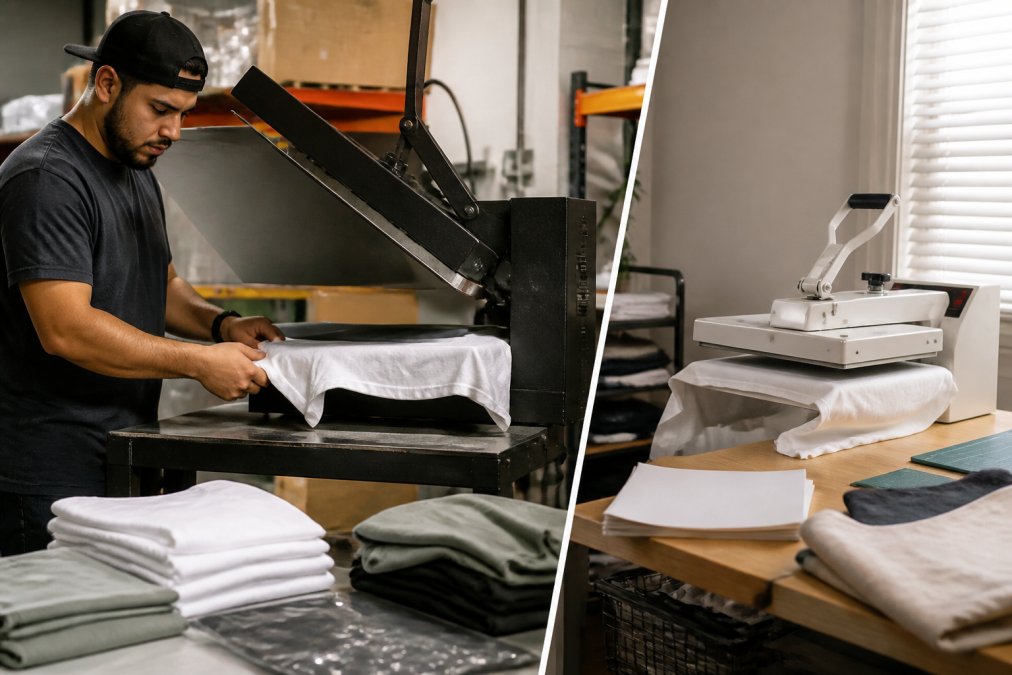
- Duty cycle: Commercial presses run for hours without cooling gaps between transfers.
- Temperature stability: The heating element holds its set point across the full platen, not just the center.
- Build quality: Steel frames, quality silicone pads, and serviceable parts separate a five-year machine from a five-month one.
Swing Away vs. Clamshell Heat Press: Which Design Fits Your Workflow?
The choice between a swing-away and a clamshell press comes down to clearance versus footprint, but what affects your bottom line is cycle time. Two presses with identical platen sizes and wattage can differ by several shirts per hour purely because of how the operator loads and unloads them.
Swing-Away Presses: Full Clearance for Thick Transfers
Swing-away designs rotate the upper platen fully to the side, giving unobstructed access and a clear line of sight, so aligning a graphic on a pocket, seam, or sleeve is faster and less error-prone. That matters most for thick transfers, sublimation work, and dimensional elements, jobs where a misload means a wasted blank.
Clamshell Presses: Compact Footprint for Tight Spaces
Clamshell presses open straight up, saving benchtop footprint and shortening the operator's hand path. The limitation is clearance: thick garments or raised transfers can be awkward to position, and the descending platen can shift a loosely placed transfer.
How Design Affects Hourly Output and Labor Cost
- Auto-open vs. manual open. An auto-open press releases the platen at the end of the dwell automatically, so the operator can prep the next garment instead of watching a timer. On a manual press, the operator waits for the timer, then lifts the handle. Across a 100-shirt run, that waiting time is pure lost labor.
- Hand travel. A swing-away forces the operator to reach across the machine to load and then swing the platen back into position. A clamshell keeps the load zone directly under the platen. On high-volume flat work, the shorter path usually wins.
- Changeover time. Swing-away presses are easier to thread with thick or odd-shaped items, so changeover between product types is faster. If your shop runs mixed orders, a few hoodies, then a run of totes, that flexibility reduces setup time per job.
Design |
Clearance |
Footprint |
Typical Strength |
Watch For |
|---|---|---|---|---|
Swing-away |
Full, unobstructed |
Larger |
Thick transfers, sublimation, detailed alignment, mixed orders |
Longer hand travel per cycle |
Clamshell |
Limited |
Compact |
Tight spaces, high-volume flat work, short hand path |
Awkward loading of thick or raised items |
How to Choose a Heat Press for T-Shirt Business Success
Choosing the right machine for a t-shirt business starts with platen size, then temperature and pressure requirements. Get those wrong and no amount of skill will fix the output.
Platen Size and Work Surface Requirements
Match the platen to your largest common transfer, not your smallest. A platen that's too small forces you to press oversized designs in sections, producing visible seams and inconsistent color. Measure your biggest standard job, then add a margin.
Temperature and Pressure Consistency
Look for a digital timer, adjustable pressure, and a heating element rated for continuous use. Temperature stability across the whole platen matters more than the top-end spec, a press that hits 400°F in the center but runs cool at the edges gives faded corners on every large transfer.
Heat Press Maintenance Tips for Long-Term Reliability
Heat press maintenance separates a machine that lasts five years from one that fails in eighteen months. The routine is simple but must be consistent and budgeted for, maintenance is a cost you plan for so it never becomes an emergency.
The Routine That Prevents Most Failures
- Wipe the platen after every session to remove adhesive residue and lint. Buildup transfers onto the next garment and causes scorching.
- Check pressure calibration weekly; springs and air cylinders drift over time, and a press that was set correctly in January may be under-pressing by March.
- Inspect the silicone pad for cracks or compression marks and replace when worn.
- Clean the heating element contacts and check wiring for wear.
- Keep the work surface level so pressure stays even across the platen.
A worn silicone pad is the most overlooked failure point: it causes uneven pressure and patchy transfers long before the machine quits. Most shops replace pads on a schedule, because a pad that looks fine can still have compressed unevenly.
What Maintenance Actually Costs Over the Machine's Life
Total cost of ownership is where a maintenance plan earns its keep: purchase price is one-time, but recurring costs determine cost per finished garment.
- Silicone pads and covers. These are wear items. A shop running daily production will go through them faster than a hobbyist, and the replacement interval shortens as volume rises.
- Heating elements and thermocouples. These are the parts most likely to fail on an otherwise sound machine. On a serviceable press, they are replaceable; on a sealed hobbyist unit, a failed element often means a new machine.
- Pressure components. Springs, gas struts, and air cylinders wear with cycles, not with calendar time. A press that runs 200 cycles a day ages its pressure system far faster than one that runs 20.
- Downtime. This is the cost most owners forget. A press that fails during a peak season does not just cost the repair, it costs the orders you cannot fill while it is down.
- Reprints. Inconsistent heat or pressure produces failed transfers, and every failed transfer consumes a blank, a transfer, and labor.
When to Repair and When to Replace
Maintenance has a decision point, and it usually arrives as a pattern rather than a single failure, often a machine needing a second or third repair within one season. At that point, the risk of another mid-season failure outweighs the repair cost.
Use this as a rough decision matrix:
- Occasional wear-item replacement (pads, covers): repair and continue. This is normal upkeep.
- First major component failure (element, thermocouple, pressure system): repair if parts are available and the frame is sound. A serviceable press is worth fixing.
- Repeat failures within one season, or parts no longer available: replace. The machine has become a scheduling risk, not just a cost.
- Consistent inability to hold temperature or pressure after calibration: replace. This is the failure mode that produces reprints, and reprints are the most expensive kind of downtime.
Scaling Up: When Volume Outgrows the Machine
Maintenance and scalability are the same conversation: a press that is reliable at 50 shirts a week can become the bottleneck at 300. The signals you've outgrown a machine are usually operational, not mechanical:
- You are turning down or delaying orders because the press cannot keep up.
- You are running the press near its duty cycle limit every day, which accelerates wear on every component above.
- You are adding shifts or operators, and the press is the constraint on both.
- Your reprint rate is climbing even though your maintenance routine has not changed.
Total Cost of Ownership: Beyond the Sticker Price
Total cost of ownership for a heat press includes the machine, replacement pads, maintenance, downtime, and reprints from failed transfers. A cheaper press that fails mid-season costs far more than the difference in purchase price.
Think in cost per finished garment. Factor in:
- Purchase price spread across expected production volume
- Consumables: silicone pads, transfer paper, vinyl
- Downtime: lost orders when a machine goes down during peak season
- Reprints: wasted blanks and transfers from inconsistent heat or pressure
Safety and Ventilation for Heat Press Operations
Heat press safety comes down to ventilation, surface protection, and operator training. Presses reach temperatures that burn skin on contact, and transfer materials can release fumes when heated.
- Ventilate the workspace. Use local exhaust or open airflow for sublimation and vinyl work.
- Protect the work surface. Heat-resistant mats prevent damage and reduce fire risk.
- Train every operator on safe loading, pressure settings, and emergency shutdown.
- Keep a fire extinguisher rated for electrical and material fires within reach.
- Follow manufacturer guidance for dwell time and temperature; running hot "to be safe" causes scorching and fumes.
Conclusion
Buying a reliable heat press for a small business is a decision about throughput, uptime, and cost per finished garment, not just the price on the tag. Get the design, platen size, and temperature consistency right, and the rest follows.
Frequently Asked Questions
What is the best heat press for a small business?
The best heat press for a small business balances durability, temperature stability, and platen size. Look for a commercial-grade machine with a digital timer, pressure adjustment, and consistent heat distribution. Swing-away designs suit thick transfers and high-volume work, while clamshell presses save space. Match the platen size to your typical garment. A reliable heat press should handle daily production without temperature swings that ruin transfers.
What features should I look for in a commercial-grade heat press?
Prioritize uniform heat distribution, a digital timer with auto-open, and adjustable pressure. Check voltage requirements and benchtop footprint for your space. A user-friendly interface reduces training time. Commercial-grade machines offer better temperature stability and machine durability than hobbyist models, which matters when scaling production or running a t-shirt business.
What is the lifespan of a heat press machine?
A commercial-grade heat press can last 10 to 15 years with proper care. Lifespan depends on heating element quality, duty cycle, and maintenance. Replacing the silicone pad and checking pressure adjustment regularly extends life. Hobbyist machines may last 2 to 5 years under heavy use.
How do I maintain my heat press for consistent results?
Wipe the platen with a soft cloth after each session to remove residue. Check the silicone pad for cracks or compression and replace it when transfers show uneven pressure. Calibrate temperature monthly with an infrared thermometer. Lubricate moving parts on swing-away models per the manual. These heat press maintenance tips prevent dwell time inconsistencies and keep your machine running through busy seasons.


